Rob Wilson, CFA
For much of the past year, South Korea was one of the world's strongest-performing equity markets. Enthusiasm for AI infrastructure and memory chips drove the benchmark KOSPI sharply higher, led primarily by Samsung Electronics and SK Hynix
Then the momentum broke
Since peaking in June, the Korean stock market (KOSPI) has fallen over 35%. On Wednesday 29 July it closed down almost 6% on the day, after triggering a market-wide “circuit breaker”, an automatic trading halt, for the second straight day. Wednesday's sell-off came after SK Hynix reported earnings that disappointed some investors, adding to broader concerns that AI-related valuations had become stretched and that competition from Chinese chipmakers could intensify. But part of the reason a correction turned into a market rout comes down to leverage.
Recently, Korean investors have bought into a relatively new product: single-stock leveraged ETFs, launched only in May, designed to deliver twice the daily move of large companies like Samsung or SK Hynix. On the way up, they were spectacular. On the way down, they were brutal. The largest SK Hynix 2× product has fallen more than 80% from its June high; the Samsung equivalent is down around 75%. Investors seeking amplified gains instead experienced amplified losses.
The political fallout has been swift. In a parliamentary hearing this week, Korea’s finance minister apologised for how these products were rolled out. Following an emergency meeting of the nation’s top financial authorities on 29 July, authorities pledged to tighten the rules, such as potentially capping single-stock leveraged ETFs at a share of each retail investor’s portfolio (one proposal would set the limit at 20%), raising trading costs, restricting the products to professional investors, and building a legal basis to intervene during extreme volatility.¹
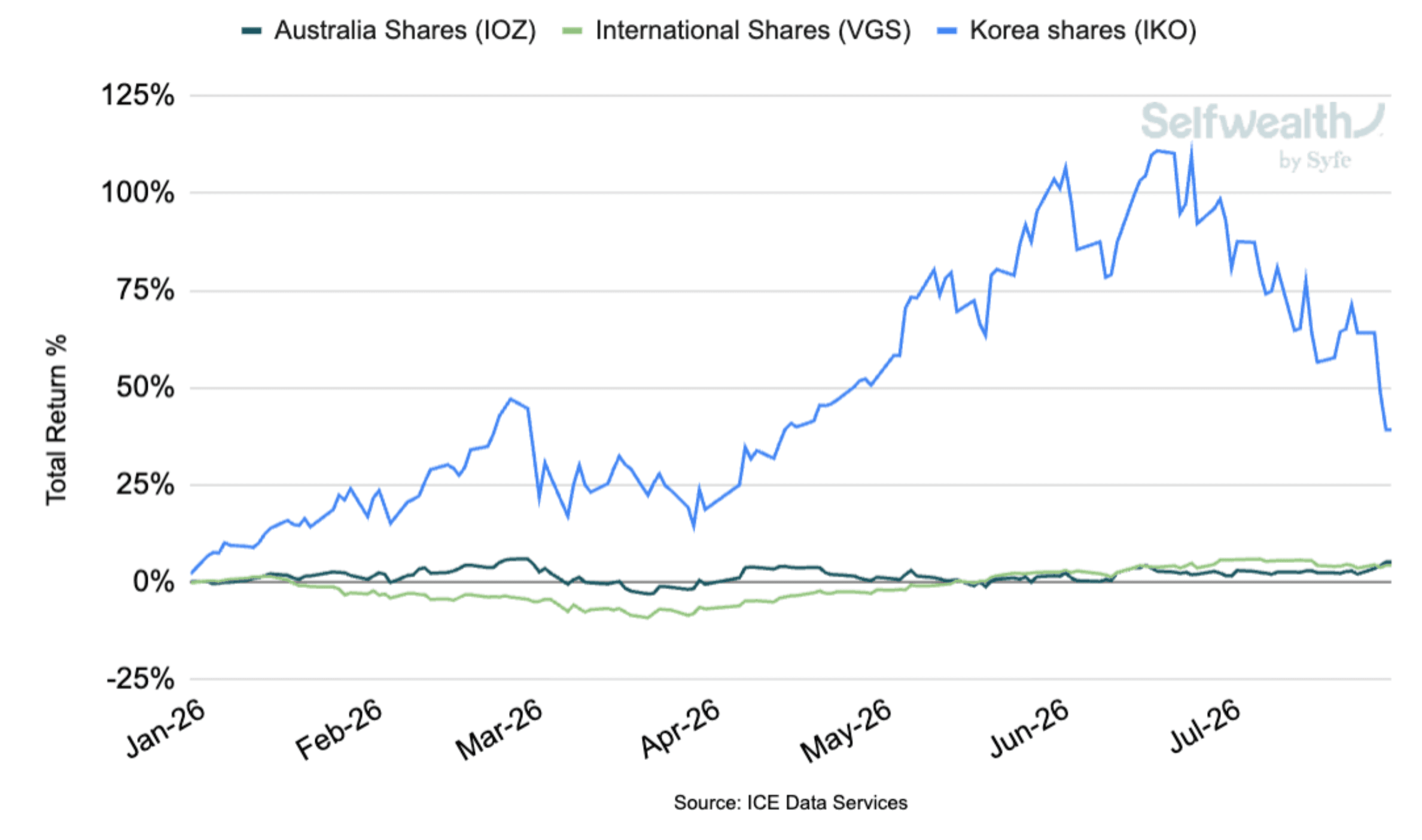
Despite the recent fall, Korea remains one of the best-performing major share markets in 2026. Korean markets also rose significantly in 2025, so this is a sharp giveback of extraordinary gains, not the erasure of ordinary ones. Samsung and SK Hynix alone drove a significant portion of the Korean market gain this year.
What actually is a leveraged ETF?
A normal exchange-traded fund (ETF) is a way to gain exposure to the underlying stocks: buy one unit of an ASX 200 fund and you own a slice of Australia’s 200 biggest companies. If the market rises 1%, your fund rises approximately 1%.
A leveraged (or “geared”) ETF typically uses derivatives and financing arrangements to magnify that move (typically aiming for two or three times the daily return). A 1% gain in the underlying index is targeted to become a 2% or 3% gain before fees and tracking differences. The appeal is obvious. The problem is twofold:
Losses are magnified too. A 2× fund turns a 10% market fall into a 20% one. A 3× fund turns it into 30%.
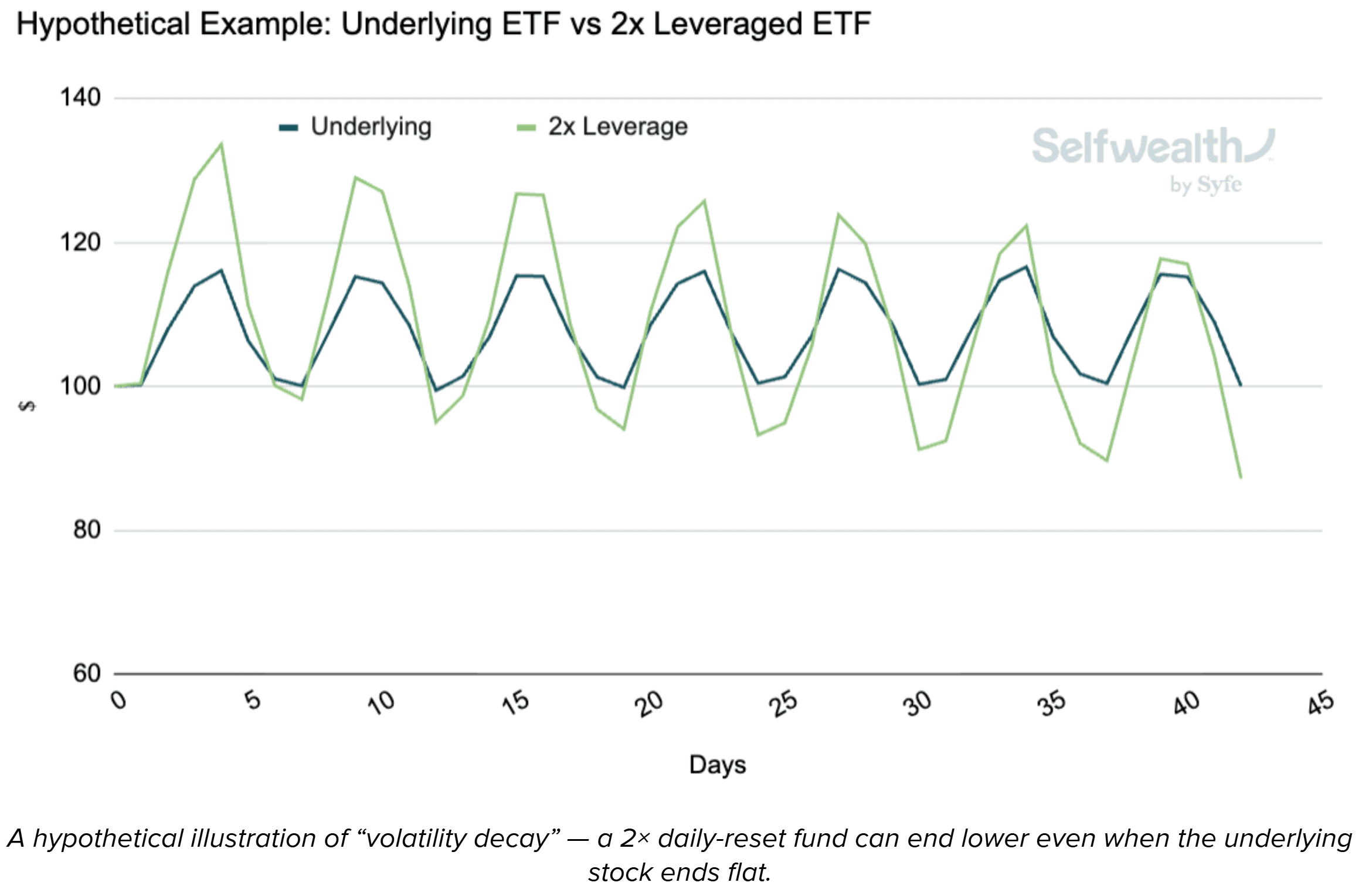
“Volatility decay” can gradually erode returns. Most leveraged ETFs reset daily, so they don’t simply deliver 2× the return over a month or a year. In choppy, sideways markets the daily resetting grinds value away, meaning you can be right about a stock’s direction over time and still lose money in the fund.
Why this matters in Australia
Korea may feel like a distant market, but the underlying risks are highly relevant for Australian investors for two reasons.
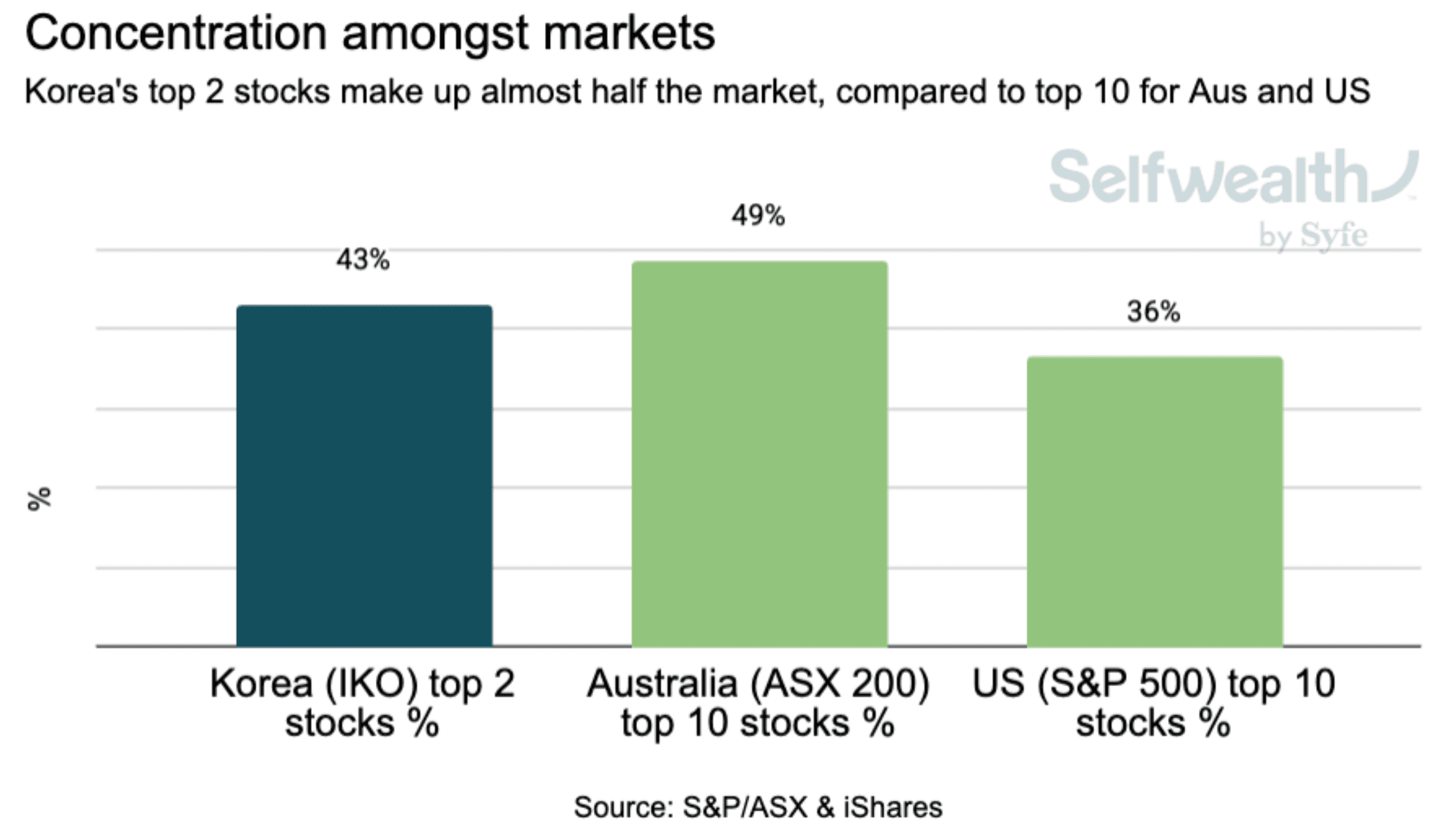
First, it's tempting to think this is a uniquely Korean story, but concentration risk exists in many markets, including Australia.. As our own H2 2026 Outlook points out, the ten largest stocks now make up about 36% of the entire US S&P 500, and Korea and Taiwan together are roughly half of the emerging-market index, each dominated by a couple of chip names. The ASX 200, meanwhile, is a heavy bet on a handful of banks and miners. What looks like diversified index exposure can quietly become a concentrated wager on a few names. Korea offers an unusually concentrated example of a broader risk that exists in many equity markets
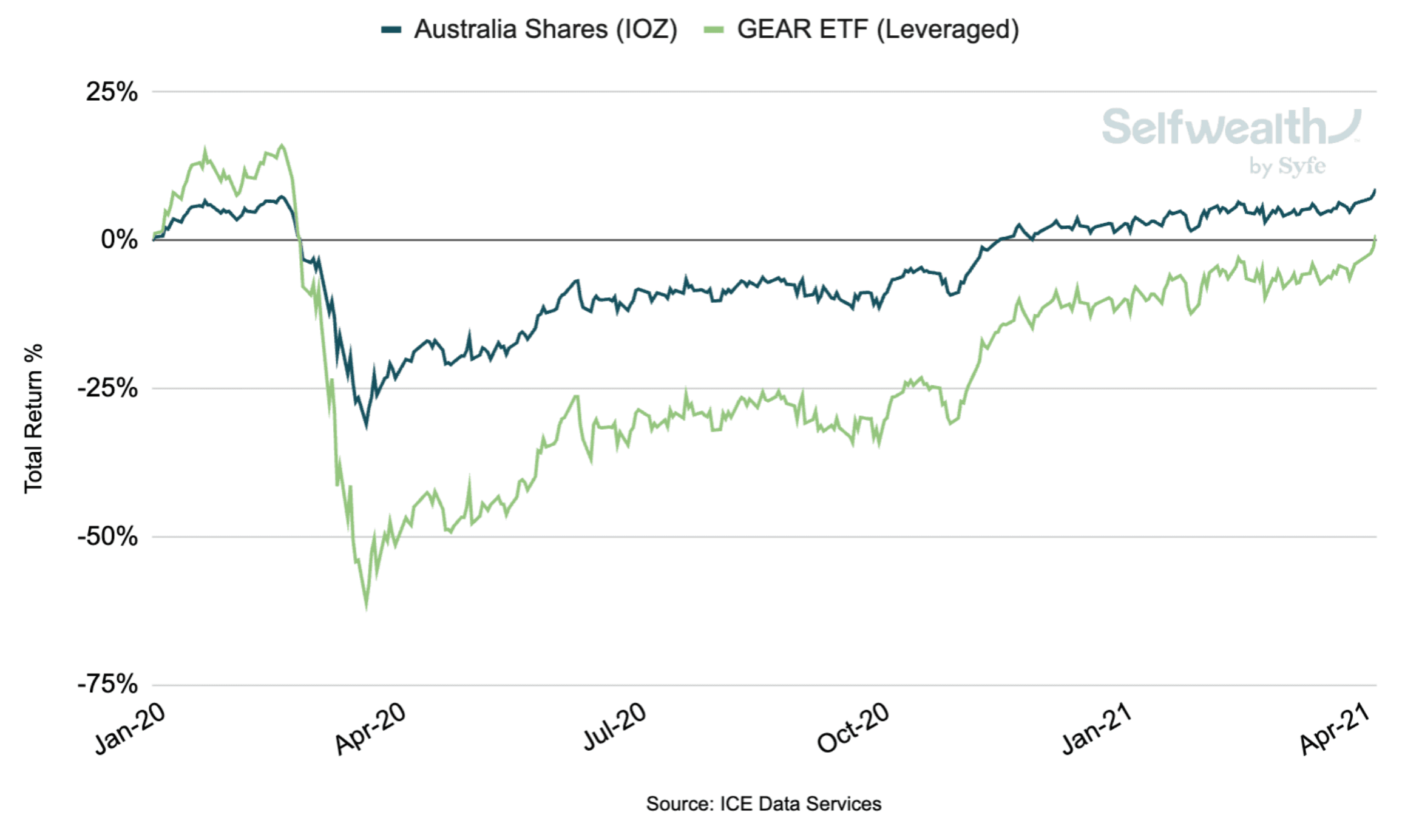
Second, Australians can buy leveraged products too. Regulators here have not approved the daily-reset single-stock leveraged ETFs that became extreme in Korea. But Australian investors can buy locally-listed geared funds on the ASX, such as BetaShares GEAR (geared Australian shares) and GGUS (geared US shares), and, if trading US markets, they can access more aggressive American products, including 3× semiconductor funds and single-stock leveraged ETFs.
An investment in GEAR ETF at the beginning of 2020 fell more than 60% during the COVID sell-off and took over a year to recover. Meanwhile, an investment in a non-leveraged ASX 200 ETF would have seen less volatility and slightly positive returns by the end of the year.
What it means for how you build your portfolio
You don’t need to swear off risk to take the right lesson from Korea. You need to structure it so no single bet can derail your long-term financial plan. Four practical ideas:
Size your themes, keep them satellites. AI and semiconductors have been among the dominant investment themes of 2026, just as the energy-transition theme led 2025 and then lagged. As the SelfWealth Outlook puts it, treat any single theme, however compelling, as a satellite around a diversified core, sized so that even a severe drawdown is survivable, not portfolio-defining. Korea is what it looks like when a theme becomes the whole portfolio.
Be honest about how much risk you’re actually taking. Leverage doesn’t just add return, it adds fragility. A geared fund that’s “up 40%” in a good year is the same product that can be down 60% in a bad one. Before buying anything leveraged, ask: if this fell 60% next month, would it derail my plans? If the answer is yes, it’s too big — or not for you at all.
Monitor leveraged and single-theme holdings closely. Daily-reset leveraged products are trading instruments, not set-and-forget investments. Ensure you understand volatility decay if using these investments.
Diversify and let time do the work. Genuine diversification means spreading across regions, sectors, asset classes and strategies. Pairing that with regular, automated investing (dollar-cost averaging) lets you accumulate through volatility rather than trying to trade around it. As our Outlook notes: portfolios should be built to survive being wrong.
Sources
Reuters, https://www.reuters.com/world/asia-pacific/south-korea-cap-investment-single-stock-leveraged-etfs-ministry-says-2026-07-29/
Important disclaimer: SelfWealth Pty Ltd ABN 52 154 324 428 (“Selfwealth”) (AFSL 421789). The information contained on this website is general in nature and does not take into account your personal situation. You should consider whether the information is appropriate to your needs, and where appropriate, seek professional advice from a financial adviser and/or accountant. Taxation, legal and other matters referred to on this website are of a general nature only and should not be relied upon in place of appropriate professional advice. You should obtain the relevant Product Disclosure Statement for any product mentioned and consider its contents before making any decision.
Most Recent Articles