
Rob Wilson
The first half of 2026 reminded investors that markets rarely move in straight lines. An energy shock temporarily reignited inflation while the AI investment boom continued to reshape global growth. Australia was not immune.
Q1 GDP growth leaned heavily on data centre construction in NSW and Victoria, illustrating how global technology investment is increasingly influencing the local economy. For investors, the halfway point offers an opportunity to review portfolios and ensure they are resilient enough for the challenges ahead.
Heading into the second half of 2026, some areas to consider are:
Diversify — Beyond increasingly concentrated indices and crowded trades.
Get selective in AI — Back disciplined disruptors that are monetising AI, not cash-strained spenders.
Navigate the inflation bump — Ripples from the energy shock could keep prices high into year-end, before disinflationary forces reassert themselves.
Capture income — Elevated yields open a rare chance to lock in income at levels unseen in years.
Anchor at home, grow with Asia — Franked income and quality on the ASX as the anchor, with selective growth exposure across emerging markets and the broader Asia region.
Australian economy: soft growth, sticky inflation
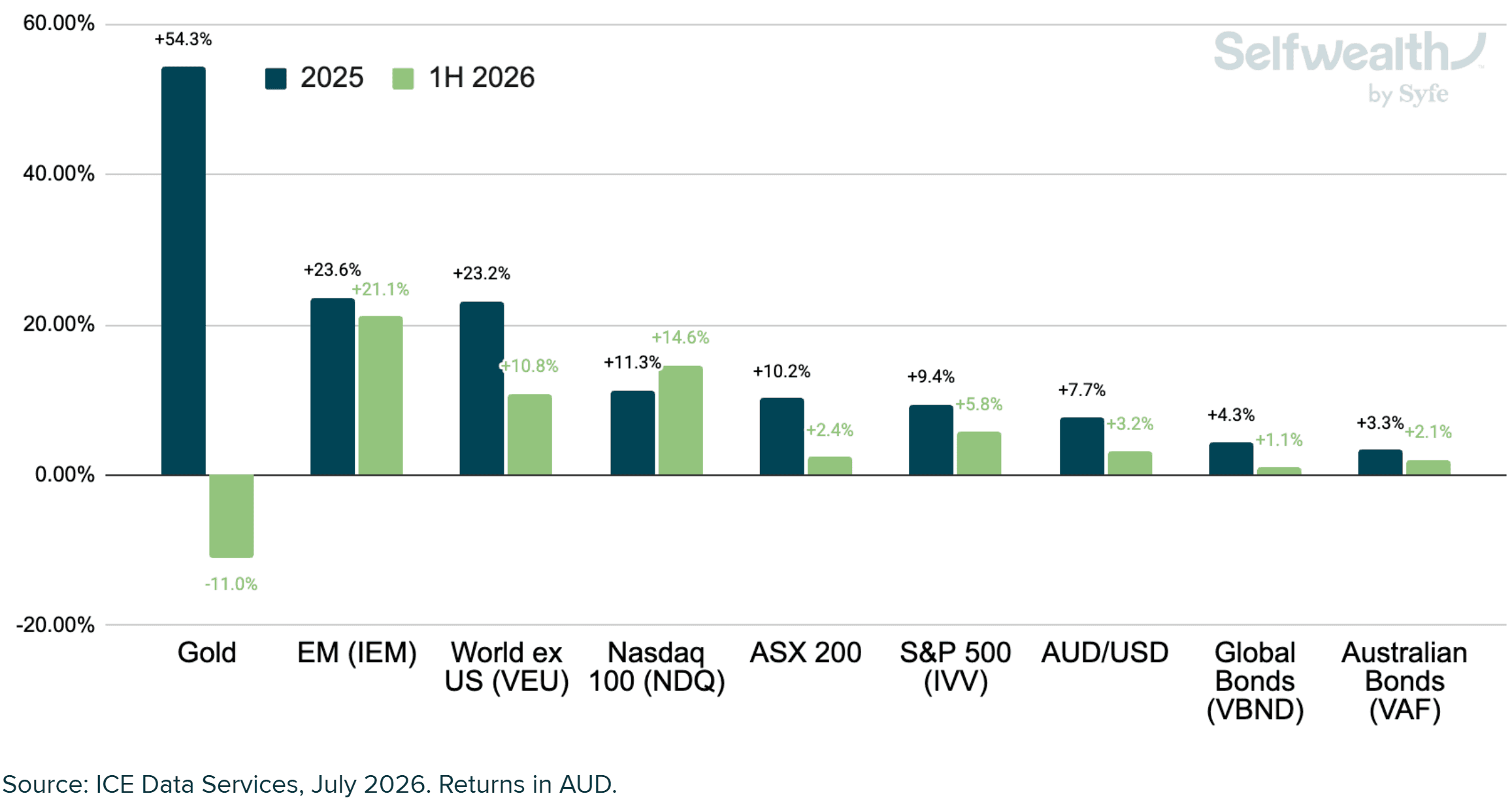
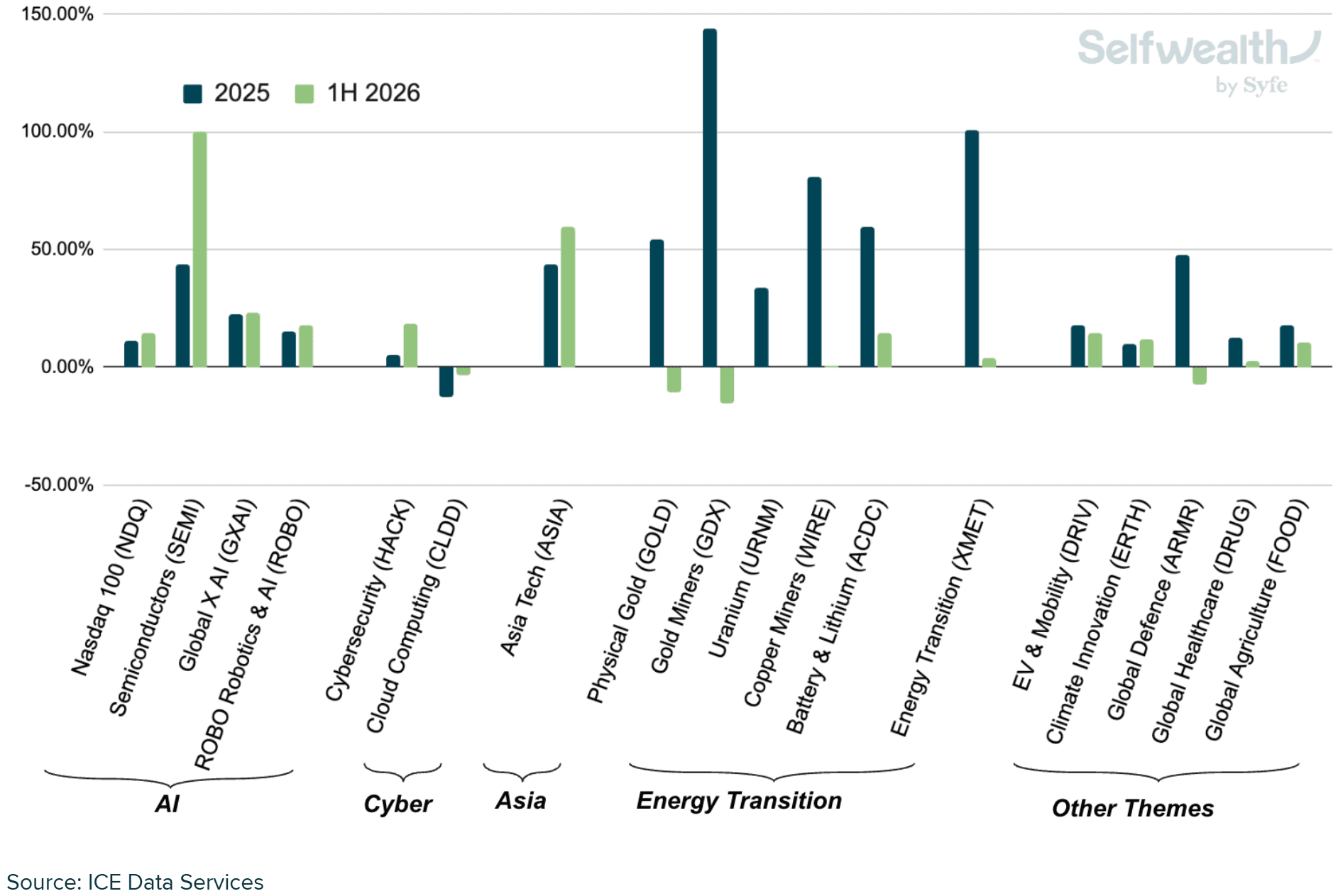
total returns H1 2026 vs full year 2025
Growth is positive, but increasingly narrow
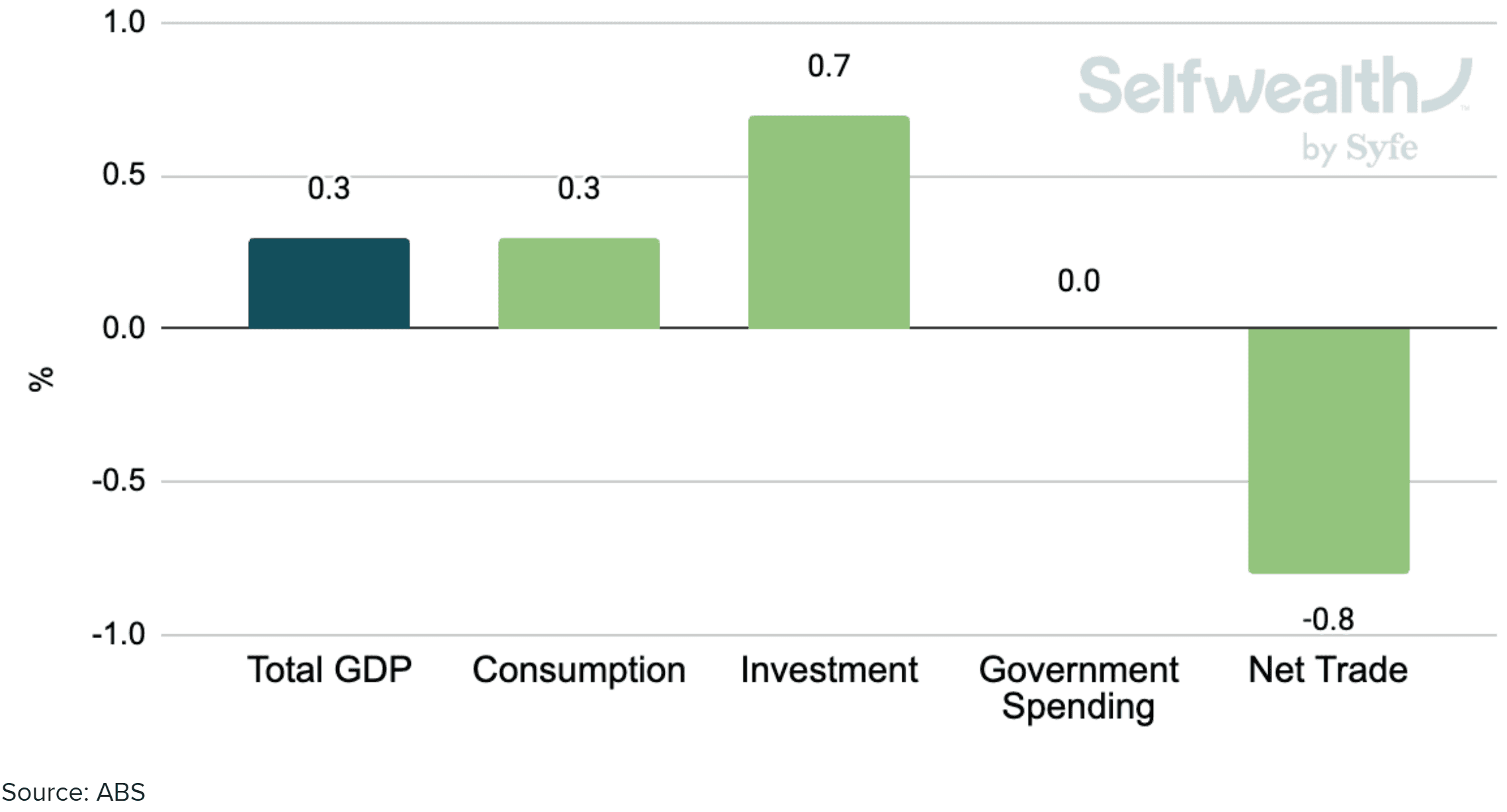
Australia avoided contraction in the first quarter, with GDP growing 0.3%. But beneath the headline, growth was uneven. Business investment (particularly data centre construction in NSW and Victoria) was the largest contributor, reflecting the global AI investment boom. Household spending remains subdued as higher living costs and interest rates weigh on consumers, while unemployment has edged up to around 4.4%.
At the same time, consumer and business confidence is tracking low. Some of that weakness likely reflects temporary pressures, including higher fuel costs and policy uncertainty, but sentiment this subdued typically translates into slower spending.
That matters because an economy driven by a handful of large investment projects is more vulnerable than one supported by broad-based consumer and business activity. While Australia's links to the global AI build-out are creating opportunities, domestic demand remains soft. It means Australia's growth pulse is now partly tied to the spending discipline of a handful of global technology companies.
Australian Q1 Contribution to GDP Growth
Inflation: better ahead, but sticky
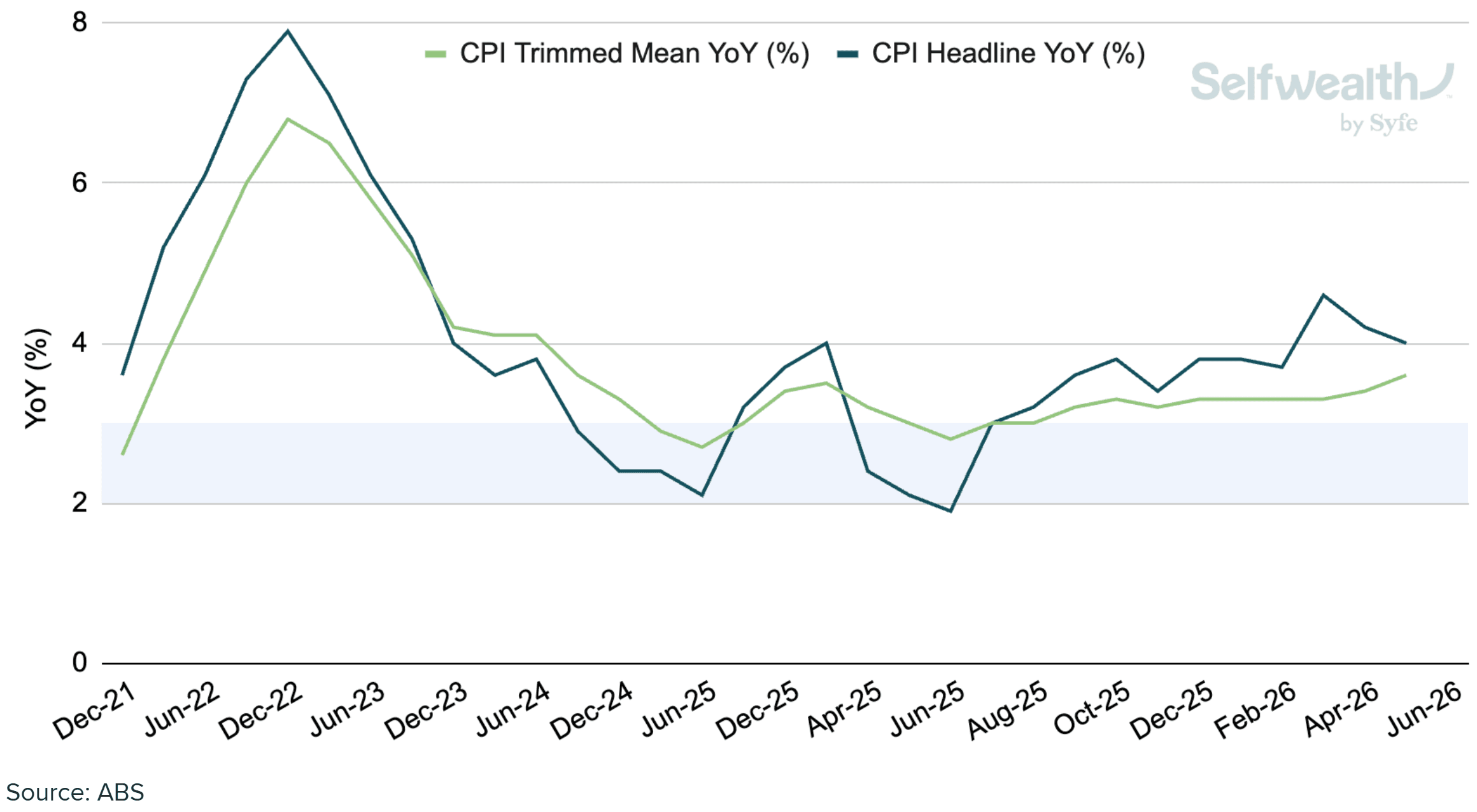
Inflation has moved in the right direction, but the journey back to target may not be smooth. Headline inflation eased to 4.0% in May as fuel prices retreated, yet underlying inflation (the RBA's preferred trimmed mean measure) rose to 3.6% and remains above its 2–3% target. Australia's inflation challenge is increasingly domestic, reflecting capacity constraints and businesses passing higher costs through to consumers.
Our base case is that inflation gradually moderates as the energy shock fades and higher interest rates continue to slow demand. However, wages, business margins and inflation expectations will determine how quickly inflation returns to target.
This backdrop explains why the RBA lifted the cash rate to 4.35% before pausing in June. Holding rates steady through the second half is our base case, with the possibility of one further hike if underlying inflation proves more persistent than expected.
Australian Inflation
One important channel to watch is the continued rollover of fixed-rate mortgages onto higher variable rates. Even without further increases from the RBA, many households will continue to experience higher repayments, keeping pressure on discretionary spending. Loan arrears remain low, but household resilience will be an important indicator through the second half.
What it means for Australian investors
The ASX enters the second half on elevated valuations but not overstretched. At around 17 times forward earnings, the ASX 200 is trading above its long-run average, although still below the valuation extremes seen in the United States.¹
Sector-wise, three themes to watch:
Energy: The first-half tailwind from higher oil prices has moderated somewhat as Middle East tensions eased. Geopolitics rarely resolves in a straight line: any renewed supply disruption likely would reprice oil quickly, and energy exposure remains one of the more direct hedges a portfolio can hold against that volatility.
Banks and consumer stocks: face the squeeze of a softening consumer and rising unemployment. Net interest margins (the gap between what banks earn on loans and pay on deposits) benefit from higher rates, but bad debts are a swing factor to watch.
Dividend payers with pricing power: Companies that can pass on costs and keep paying fully franked dividends are well suited to a world where rates stay elevated and inflation, while improving, hasn't been beaten yet.
Overall, Australian investors don't need to abandon the local market; it remains an attractive source of quality companies and tax-effective income. But the ASX is heavily concentrated in banks and miners, so a home-market allocation should form the portfolio's anchor, not the whole portfolio. Diversifying internationally remains just as important as diversifying across sectors.
Avoid the crowd: Index hugging is not enough
Global markets overcame extraordinary challenges to close the first half of 2026 near record highs. The rally was supported by strong fundamentals in earnings growth. Even the Iran conflict could not derail the grind higher; Q2 was the S&P 500's best quarter in six years. A closer look, however, reveals the underlying risks:
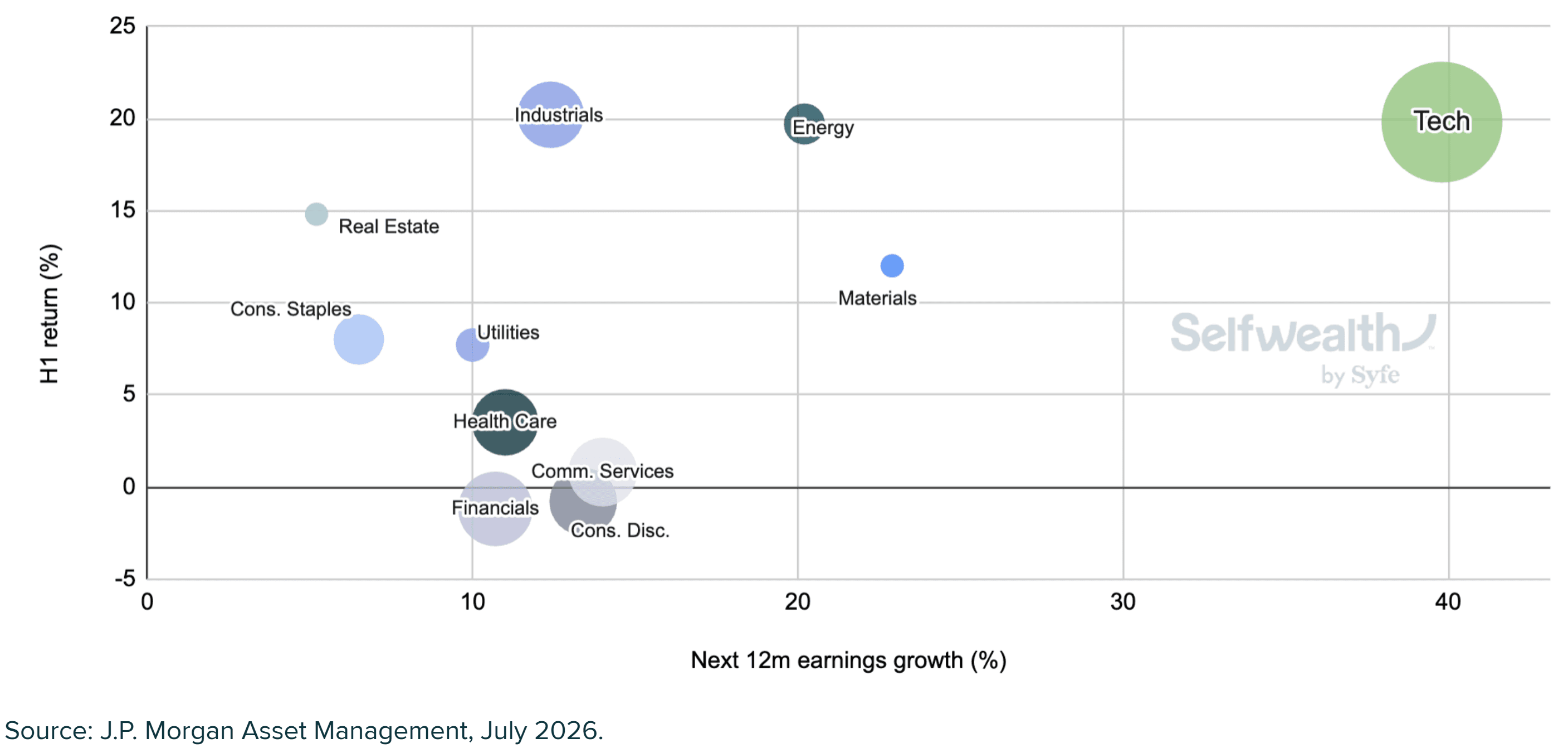
AI’s dominance means half of US earnings growth is dependent on the tech sector. The 10 largest stocks are about 40% of the S&P 500. Together, Korea and Taiwan account for around half the market capitalisation in emerging markets (these two markets are themselves dominated by a couple of semiconductor stocks).²
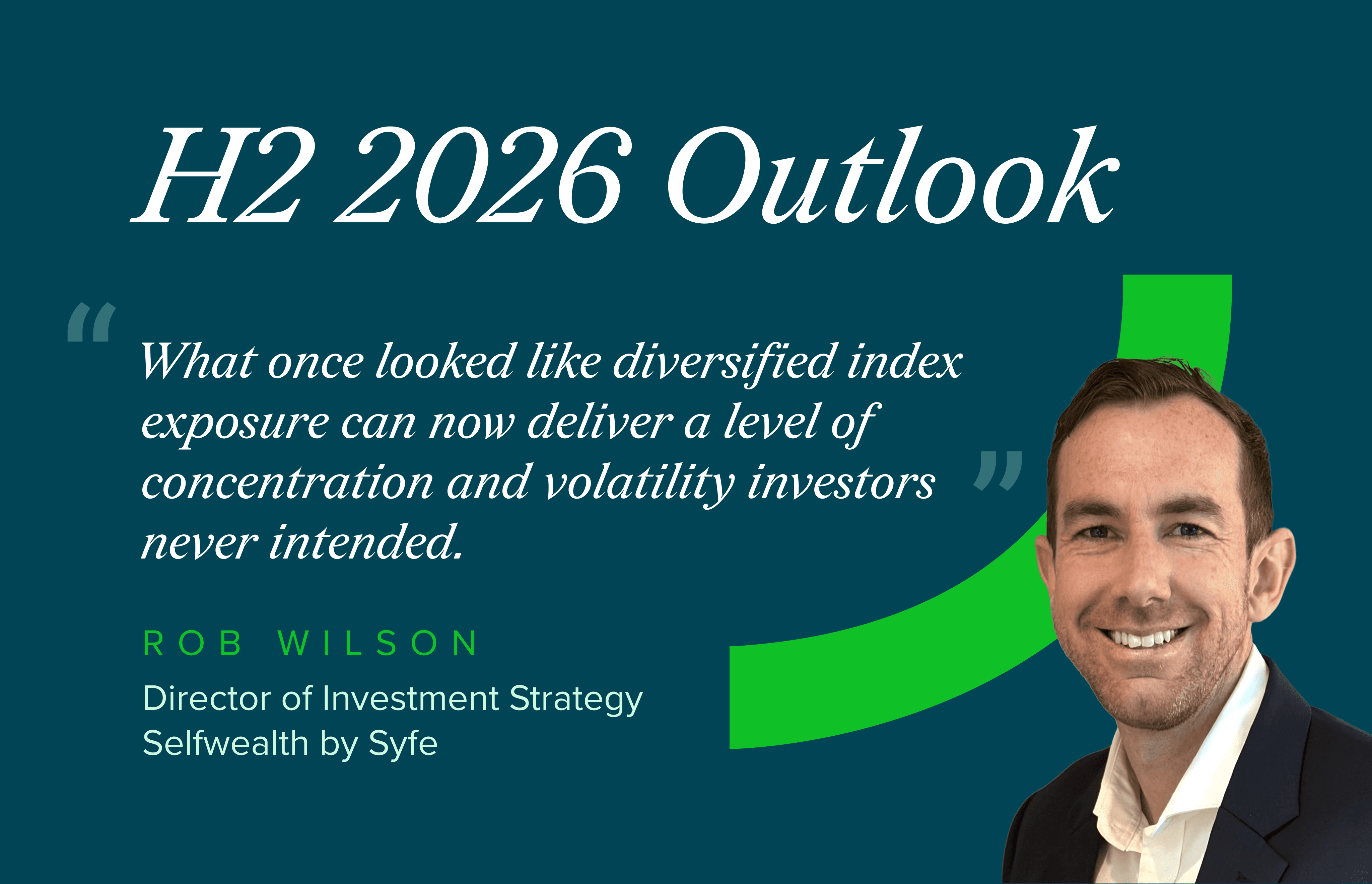
What once looked like diversified index exposure can now deliver a level of concentration and volatility investors never intended.
To put the concentration in perspective: for the top 10 stocks' weight to fall back to the ~20% often seen before 2020, they'd have to stay flat while the other 490 rally over 160%.³
Bubble size represents weight in S&P 500
Leadership rotates, don't anchor to last year's winner. 2025 was the year of the energy-transition theme (clean power, grid, batteries); 2026 has been the year of AI and semiconductors, while the oil and gas sector was 2026's cyclical standout during the peak of the conflict. Last year's must-own
theme became this year's laggard, and there's no guarantee this year's leaders will dominate 2027. That argues for treating any single theme, however compelling, as a satellite sized so its drawdown is survivable, not portfolio-defining, and for pairing strategies that generate returns differently rather than relying on one passive tracker.
Rotating thematics
What it means for Australian investors: Diversification today means more than owning an index. Australian investors already have significant exposure to banks and miners through the ASX, while global indices are increasingly dominated by US technology giants. Broadening exposure across regions, asset classes and investment styles can reduce concentration risk without giving up growth opportunities.
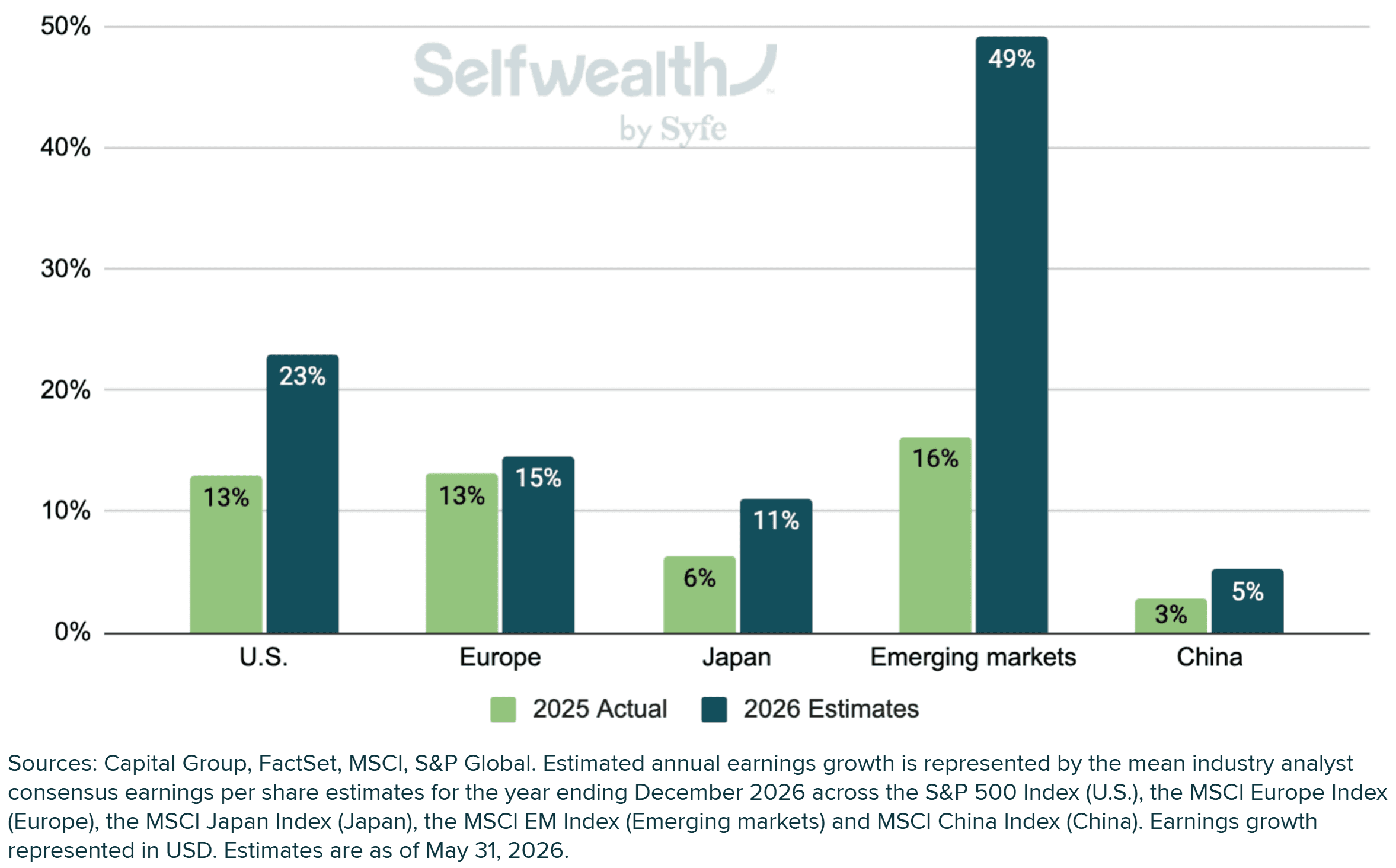
Regionally, we prefer emerging over developed markets: for stronger earnings growth and more reasonable valuations. China and India, whose combined GDP is nearly half of EM, offer breadth unavailable elsewhere, spanning cyclicals, consumer stocks and newly minted tech names.
Australia is not immune: the ASX 200 is heavily weighted to a handful of banks and miners, so an "Australian equities" allocation is a bigger bet on financials and resources than many realise. Anchoring at home for income still makes sense, but pair it with real diversification rather than treating the local index as diversified in itself.
Thematics: pair strategies that return differently and keep any single theme satellite-sized.
EPS growth year-on-year across major markets (USD)
AI: Time to get selective
Underpinning equity strength is the accelerating AI build-out: capital expenditure on the chips, data centres and power infrastructure that AI requires. The numbers are significant:
Hyperscaler (cloud computing providers) capital expenditure for 2026 has been revised up again, with consensus estimates now approaching ~US$800bn.⁴
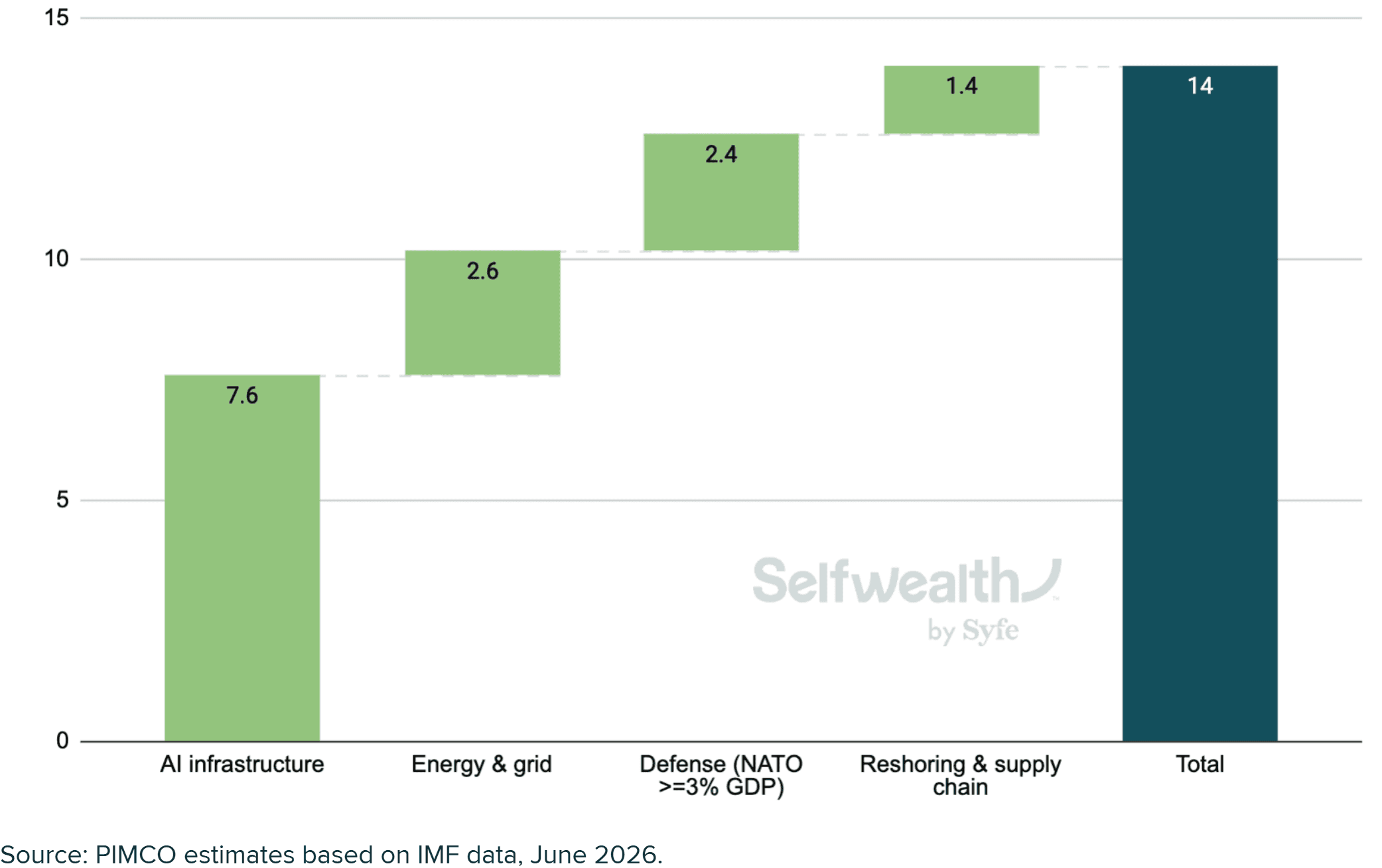
The combined AI, defence and energy-security investment cycle could add up to ~US$14 trillion to global capital spending over roughly five years, on PIMCO estimates. That's already big enough to move macro numbers in the US and, as our Q1 GDP showed, in Australia.
What markets care about, though, is not just today's spending but tomorrow's payoff. Investors in the first half favoured hardware over software, and disciplined monetisers with real earnings over cash-burning spenders. The rise of agentic AI wiped ~US$2 trillion off software stocks at one point on fears it will upend existing business models. Capital expenditure is expected to consume around 94% of hyperscaler operating cash flow (up from a historical average of around 40%) and some have turned to debt for funding.⁵ The bear case is that the spend may not earn its keep if hardware depreciates faster than expected or before revenue arrives.
Cumulative capital expenditure 2026-2030 (US$ trillions)
What it means for Australian investors: Australian investors should think beyond simply "owning AI." We favour companies generating sustainable earnings from the AI build-out rather than those undertaking the largest spending programs. While much of the opportunity sits offshore, Australia's growing data centre, power infrastructure and industrial sectors may also benefit from the investment cycle.
Enablers over spenders. We favour the companies building the memory, logic, networking and heavy-asset, low-obsolescence infrastructure AI actually runs on.
Hardware caution. Opportunity is in chipmakers supplying the build-out, but their extraordinary momentum means they trade at high valuations; justified for now by genuine supply bottlenecks, but a premium that rests on how long the scarcity lasts.
Software potential. Greater opportunity may sit in stocks that have already corrected. After a strong sell-off, leading software names regained momentum by shifting from charging per user to charging for the work their AI performs, so revenue holds up even as automation replaces headcount. Attractive valuations plus improving earnings could support the adapters in the second half.
Navigate the inflation bump
Inflation has been one of the biggest surprises of the year so far. Prices were set to ease in the first half on a softer economy and stronger productivity. Then came the Iran conflict: a historic energy shock that sent Brent oil up 50% to ~US$120/barrel, pushing US headline inflation to 4% (the highest in about two years) as price pass-through hit consumers.
Against this backdrop, the US Federal Reserve shifted its priorities — from supporting growth to keeping a lid on inflation. The first rate-setting meeting under new chair Kevin Warsh confirmed it: a hawkish hold (holding interest rates steady while retaining a bias towards a hike). Around half of the policymakers are pencilling in a hike by year-end, and markets are pricing a potential hike too. Warsh left room for manoeuvre, noting a lack of "conviction" around those projections. If inflation evolves differently through the second half, the Fed's path could change with it.
There are good reasons to think the bump fades:
The energy shock is likely temporary as conflict and tensions ease over time. Energy is also a much smaller share of consumer prices than in the 1970s.
Shelter (rental costs), about a third of US CPI, is running cooler than a year ago as rental vacancies rise.
The AI build-out, initially inflationary, should become increasingly disinflationary as productivity gains land.
But we'd hold that view with some humility. Second-round effects (wages, margins, expectations) haven't had time to fully come through, underlying measures (Australia's included) are still rising, and a heavy geopolitical calendar means the supply-shock risk hasn't gone to zero.
Our base case: disinflationary forces regain the upper hand into 2027, central banks stay in "hawkish hold" mode through the second half, and rate cuts are delayed — but the risks around that path tilt toward tighter for longer rather than easier sooner.
US inflation: Energy price rise likely short-lived, shelter the opposite

What it means for Australian investors: For Australians, the key question isn't just what the US Federal Reserve does, it's whether the RBA can begin easing. Our base case is that domestic inflation keeps Australian interest rates higher for longer, supporting income assets while making quality companies with pricing power increasingly valuable.
Capture income: get paid to wait
The flip side of higher-for-longer is one of the better income environments in over a decade. Higher cash and bond yields mean portfolios can once again earn a meaningful portion of total return through income, not just capital gains.
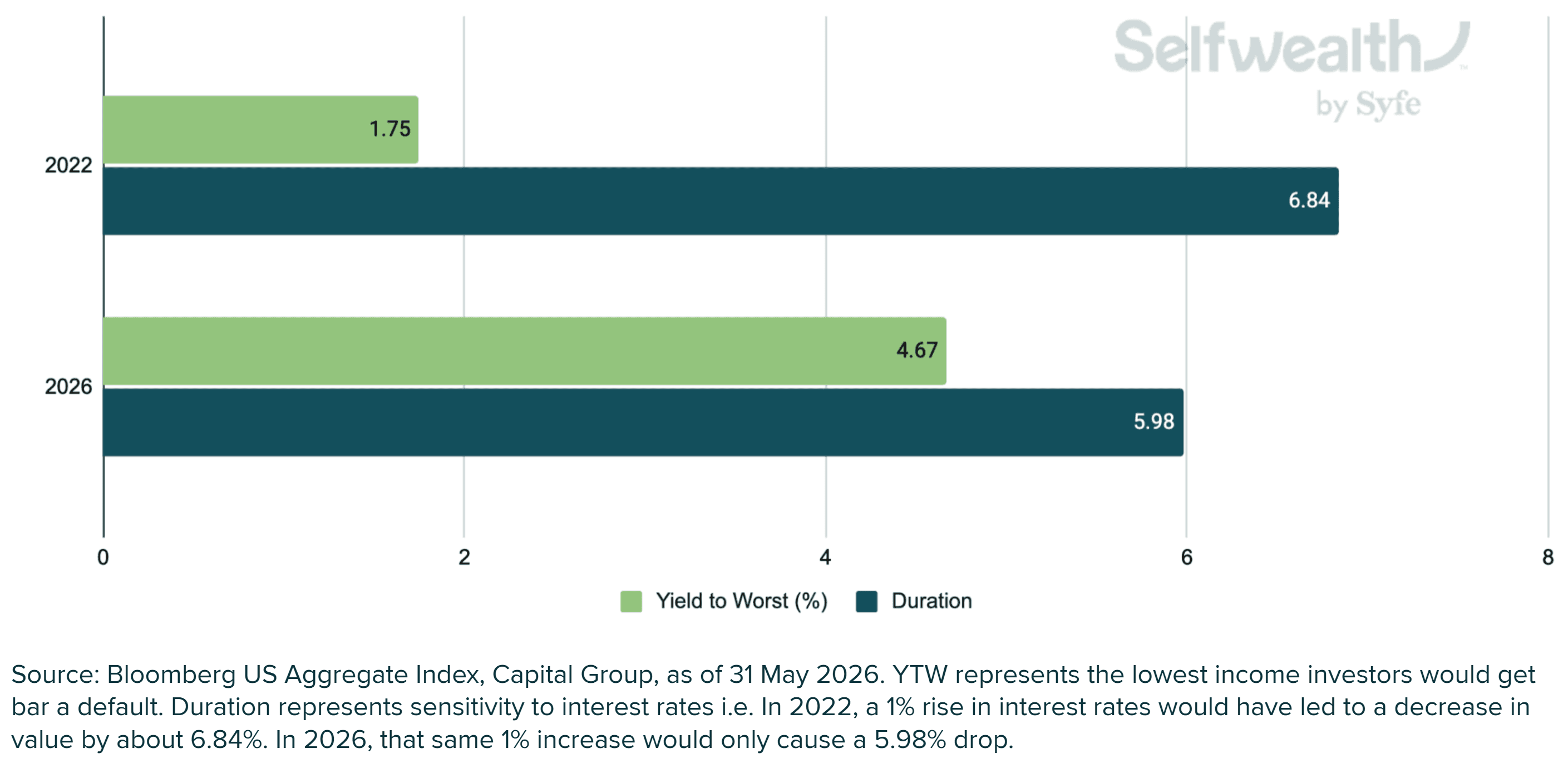
Starting yields are a strong predictor of forward returns, and they have climbed to levels unseen in years; 10-year US Treasury yields topped 4.5%, and the Australian 10-year Government bond yield topped 5%. Compared with the 2022 yield surge, bond investors today take on less interest-rate risk (duration) for more return potential (yield to worst).
What it means for Australian investors: Australian investors are in a stronger position than they've been for years. Cash, bonds and fully franked dividends can once again generate meaningful income.
Globally, we prefer medium maturities (particularly 5–7 years): they pay almost as much income as long bonds (>4%) with less rate sensitivity. Reaching beyond 10 years is less enticing given long-term fiscal pressures in developed markets and a heavy political calendar (US mid-terms, UK premiership change).
At home, the income story is amplified: With the cash rate at 4.35%, cash and money-market yields finally pay you to hold liquidity, even as bond returns start to rival equities. Layer on the ASX's fully franked dividend yield, one of the most tax-effective income streams available to Australian investors, and a blended portfolio can target meaningful income with far less reliance on rising markets.
A word on gold. With rates elevated, non-yielding gold inevitably becomes less attractive. After years as the go-to geopolitical hedge, the trade has become more positively correlated with risk assets than many investors expected. Gold's long-term store-of-value role stays intact and central-bank buying could continue, but its near-term diversification benefits come at a discount.
Less Risk, Higher Income: Bloomberg US Aggregate Index
The view from home: anchor in income, grow with Asia
For an Australian investor, home is a natural anchor and, right now, potentially a productive one. Fully franked dividends from quality ASX companies deliver tax-advantaged income on top of already-elevated cash and bond yields.
The growth side increasingly points to Asia, beyond the crowded Korea and Taiwan semiconductor trades. China offers AI and policy-driven opportunities, India's earnings outlook is improving, and Japan continues to benefit from corporate reform and rising capital investment.
Positioning matters, particularly in China. Growth is on track (5% in Q1), but the economy is increasingly "K-shaped" (different parts moving in opposite directions at once) with record chip and computer exports on one side and weak retail spending and a soft property market on the other. This feeds straight into Australian portfolios: China's soft property sector and lagging domestic demand are the main drivers of iron ore prices, so a K-shaped China flows through to the large miners and, given their index weight, to anyone holding the ASX 200. The upside case for the big miners rests less on China's headline 5% growth than on whether Beijing's stimulus reaches the steel-intensive parts of the economy.
What it means for Australian investors: Australia is a natural portfolio anchor through quality companies and tax-effective franked dividends. Long-term growth opportunities increasingly lie across Asia, where structural earnings growth is broader than many developed markets. Combining a strong domestic core with selective international exposure can help investors balance dependable income with long-term growth.
On the currency: the AUD faces a tug-of-war in the second half. A firm US dollar, supported by a hawkish Fed and the aftermath of the war, puts downward pressure on it, but the RBA's higher-for-longer stance and elevated domestic rates provide an offsetting anchor. Our base case is that the two forces roughly cancel out, leaving AUD/USD range-bound near current levels. Practically, that means currency is unlikely to be a major driver of returns either way in the second half, but the balance of risks is worth keeping in view when deciding how much of your international exposure to hedge.
Risks and scenarios
The bull case: oil stays low, disinflation arrives faster than expected, central banks pivot toward neutral, and AI earnings keep beating. Equities re-rate higher, led by rate-sensitive sectors and the broadening trade; bonds rally too.
The base case: inflation grinds lower but stays above target through year-end; the Fed and RBA hold in hawkish mode (a hike from either is possible but our base case is that meaningful easing is more likely in 2027 than in late 2026); growth is soft but positive; equities deliver modest, earnings-driven gains with more volatility; income assets quietly compound at their best yields in years.
The bear case: renewed geopolitical escalation or wage-price persistence forces more tightening than economies can absorb. Unemployment rises faster, and richly valued equities sell-off with concentrated, AI-heavy portfolios hit hardest. In this world, quality bonds, income and genuine diversification earn their keep.
The key lesson of the past twelve months (an oil shock, a hiking RBA, and markets pricing Fed hikes in 2026) is that tail scenarios happen. Portfolios should be built to survive being wrong.
Considerations for the second half
Stay invested, stay genuinely diversified: across regions, asset classes, themes and return sources, not just across a US index of 500 stocks that increasingly move as ten.
Consider today's income opportunities. At today's yields, bonds and franked dividends can carry a real share of your return target.
Don’t try to time it. Dollar-cost averaging lets you accumulate through volatility rather than trying to trade around it.
Size your themes. Use themes such as AI as a satellite around a diversified core. Recall that the energy-transition theme was 2025's standout and 2026's laggard.
Sources
JP Morgan Asset Management, Guide to the Markets, July 2026. The S&P 500 forward PE is ~20.3x, above its longer average of ~16.9x.
MSCI Index weights (S&P 500 top-10; MSCI EM; MSCI EM GDP-Weighted country weights).
D. E. Shaw & Co., "The Concentration Game," February 2026.
AI capex scale and macro impact — Goldman Sachs
PIMCO, “AI Credit Expansion: Assessing the Micro and Macro Risks”, May 2026
Important disclaimer: SelfWealth Pty Ltd ABN 52 154 324 428 (“Selfwealth”) (AFSL 421789). The information contained on this website is general in nature and does not take into account your personal situation. You should consider whether the information is appropriate to your needs, and where appropriate, seek professional advice from a financial adviser and/or accountant. Taxation, legal and other matters referred to on this website are of a general nature only and should not be relied upon in place of appropriate professional advice. You should obtain the relevant Product Disclosure Statement for any product mentioned and consider its contents before making any decision.
Most Recent Articles