Rob Wilson, CFA, Director of Investment Strategy
Regular Income, Without the Work
Introducing Selfwealth Income+
Higher interest rates have made income investing more attractive than it has been for years. Our Income+ Portfolios are built to pay you a regular income from your investments without locking your money away, and without asking you to pick and manage holdings yourself. They're managed day to day by our investment team and built using high-quality ETF building blocks from leading global asset managers, so you get diversified income exposure without doing the work.
Answer a few questions and you'll be matched to the portfolio that suits your goals. There are two income portfolios:
Income+ Defensive. For steady, monthly income with stability of your investment as the first priority.
Income+ Enhance. For a higher income potential by taking on measured additional risk.
In this article
What’s in each Income+ portfolio
Managed for you. Are there any conditions?
Understanding income and yield
What it costs
Investment Process: How Income+ is built
Why ETF building blocks
Income payments: Paid monthly or re-invested
What to know before you invest
Getting started
Disclaimer
What’s in each Income+ portfolio
Both portfolios are built mostly on lending. When you buy a bond, you're lending money to a government, a bank or a company, and they pay you interest for it. That interest is what makes bonds a useful source of income.
Income+ Defensive is designed to provide regular income while prioritising the stability of your investment. It holds a variety of diversified bonds, lending across a spread of borrowers: banks, companies and governments, both in Australia and overseas. Some of those loans sit further back in the queue for repayment if a borrower runs into trouble (subordinated debt), which is why they pay more. It's for income-seeking investors who want a smoother ride and place a higher priority on stability
Income+ Enhance is for a higher income potential, and to grow your investment over time. It has similar exposures to Defensive and adds shares. Shares bring two more sources of income: the dividends companies pay, and money earned from options strategies. They also give Enhance more potential to grow your underlying investment. It's for investors who are comfortable with more movement in their portfolio in exchange for more income and some growth potential.
Here is a summary of the two portfolio metrics:

What’s not in them
Neither portfolio invests in private credit — loans made directly to companies, outside public markets. Those loans can pay more, but you're taking more risk to get it, and your money is usually tied up far longer with fewer chances to get out. Everything these portfolios hold is listed on the ASX and can generally be bought and sold on any trading day.
Managed for you. Are there any conditions?
Once you're invested, the day-to-day work is handled for you. Everything is visible in your Selfwealth dashboard.
No minimum investment, and no entry, exit or transaction costs
No lock-ups (withdraw anytime)
Income paid monthly, or reinvested automatically
Rebalancing handled for you, with tax efficiency in mind
Full transparency on cost, performance and every holding, in your SelfWealth dashboard
Ongoing monitoring. Selfwealth's investment team monitors the portfolios for you and reviews the target allocations over time as market conditions, yields and credit conditions change.
Automatic rebalancing. As markets move, a portfolio's actual weights drift away from their targets. The portfolios are rebalanced back toward their target allocation on a periodic basis, so your risk and income profile stays aligned with the portfolio you chose. Investing in an Income Portfolio automatically opts you into this.
Tax efficiency in mind. Rebalancing and portfolio changes are carried out with tax efficiency as a consideration, so the process of keeping your portfolio on track does the least it can to your after-tax return. Because part of Income+ Enhance is invested in Australian shares, distributions from that allocation may also carry franking credits, which can be relevant to your after-tax income. Tax outcomes depend on your personal circumstances.
Understanding income and yield
Income, yield and total return are often confused, but they are three different things.
Income is the cash the portfolio pays out. In other words, the distributions from the underlying ETFs, paid monthly. Income from shares is often called dividends, income from bonds coupons, and income from funds distributions.
Yield, or distribution yield, is that income as a percentage of what your investment is worth. It's a useful way to compare income across investments of different sizes and types.
Total return is everything you end up with: the income paid out to you, plus or minus any change in the value of your investment.
The last two are the ones people often confuse. A yield tells you what you're likely to be paid. It doesn't tell you what your investment will be worth at the end of the year. We've worked through that difference with real dollar figures here: [Income, yield and total return]
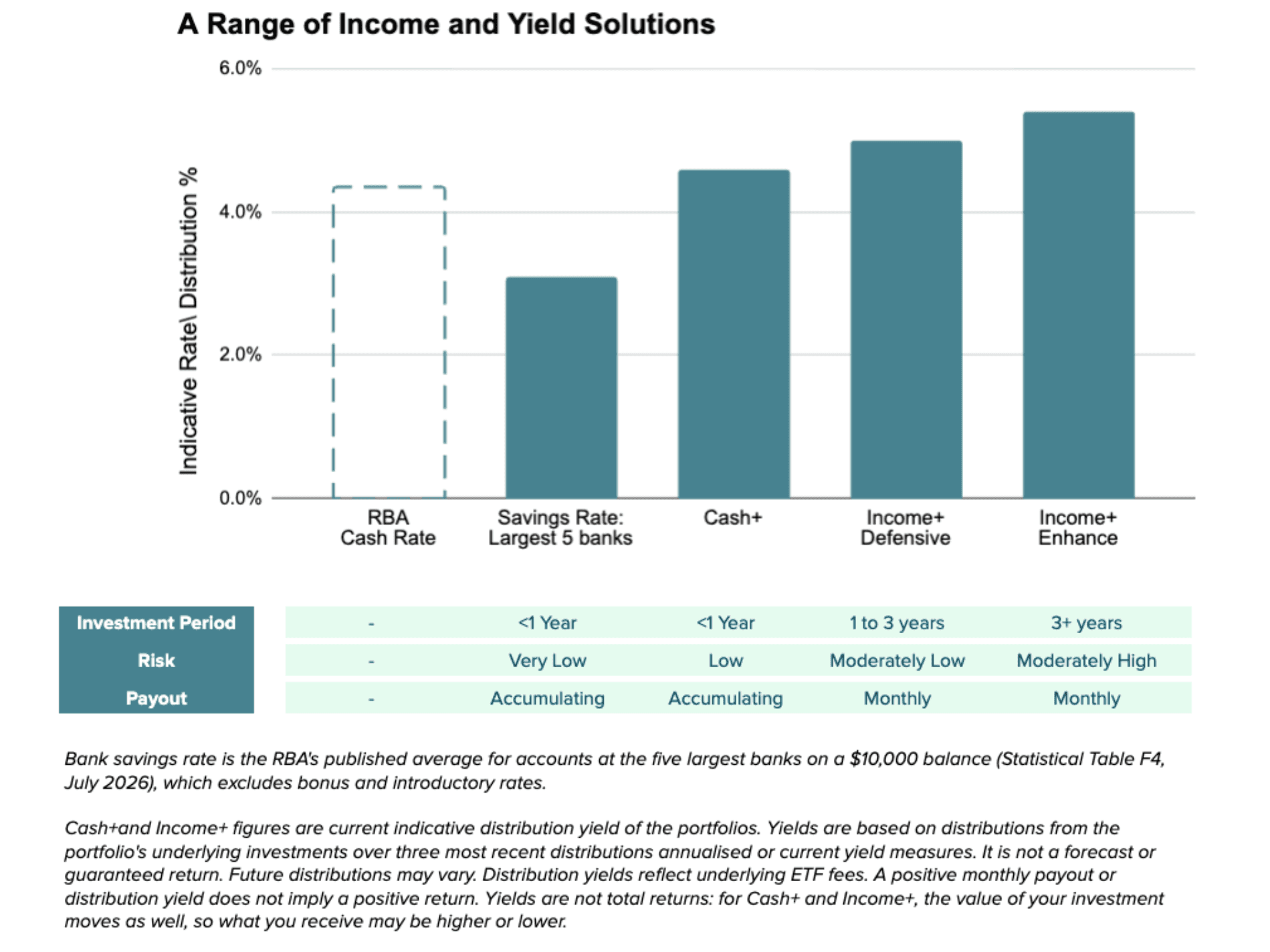
After the fees charged by the underlying ETFs, the distribution yield is 5.0% for Defensive and 5.4% for Enhance¹. It is an estimate, not a promise. For context, the RBA cash rate is currently 4.35% (as of 31 August 2026).
¹ Indicative distribution yield is calculated based on distributions from the portfolio's underlying investments over three most recent distributions annualised or current yield measures. It is not a forecast or guaranteed return. Yields reflect underlying ETF fees. Future distributions may vary. Past performance is not a reliable indicator of future performance.
Income+ Defensive holds bonds, whose prices move when interest rates move. Income+ Enhance holds those plus shares, which can move a great deal. In a good year your total return could land well above the yield. In a poor one it could land below it, or be negative, while the monthly payments keep arriving on schedule. The yield is what you're paid. It isn't what you make.
The chart below shows how differently that plays out across asset classes. It covers the three years to July 2026 for cash, Australian bonds, Australian shares and US shares. The black dot on each bar is the total return. The bar shows how much of that came from income, and how much from a change in price.
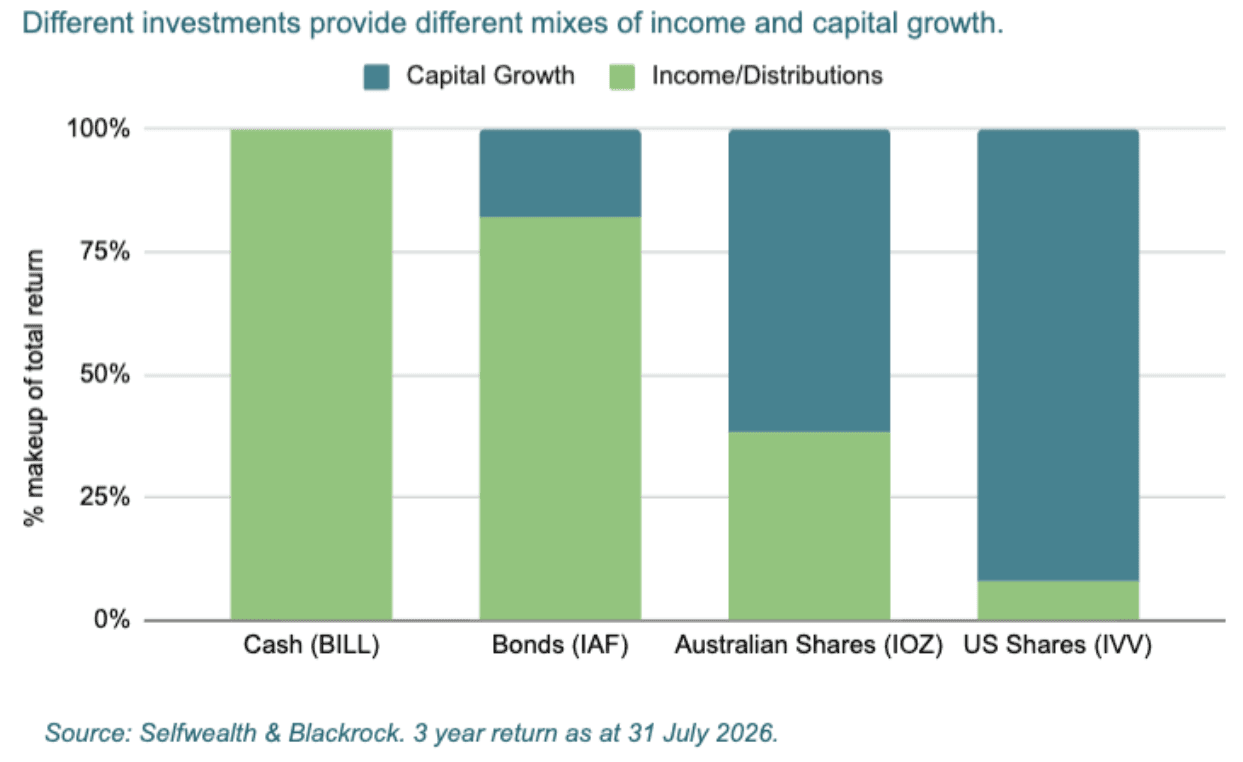
Cash: income is almost all of the return. The price barely moves.
Australian bonds: income stays positive, while price changes can add to or subtract from the total.
Australian shares: income is a meaningful part of the return, and price changes can swing the total a long way in either direction.
US shares: income is a much smaller part of the story. Most of the return comes from prices rising.
Income+ Defensive sits closest to the bonds bar. Income+ Enhance sits between the bonds and Australian shares bars, which is where its extra income and its extra movement both come from.
What moves the yield
The two portfolios don't react to the same conditions in the same way.
Income+ Defensive is driven mostly by interest rates. Most of what it holds resets its interest rate as official rates move, so the income follows within a few weeks. The rest is fixed for longer and takes more time to catch up. There's a second driver: what lenders are charging borrowers. When lenders demand more to lend, newly bought loans pay more. Either way, nothing is locked in the way a term deposit is. If rates rise the yield generally rises, and if they fall it falls.
Income+ Enhance moves with rates too, but less of it does. Its dividend and options income depends on how companies and share markets are performing, not on what the RBA decides. That makes its yield steadier when rates fall, and less responsive when they rise.
What it costs
The Selfwealth management fee for Income+ is 0.05% to 0.45% p.a., depending on how much you have invested. See our [pricing page] for full details. There is no fee on contributions or withdrawals, and no entry or exit fees.
Investment Process: How Income+ Portfolios are built
Researching income ETFs, deciding how much to hold of each, and keeping that mix on track is real work. We do it for you, and we watch the portfolios every day.
Selfwealth's investment team built both portfolios to achieve a reliable monthly income, without giving up more total return than we have to.
We start with a shortlist of income-producing investments we'd be comfortable holding; lending of various kinds, bonds, and income-paying shares that are all listed securities, easy to buy and sell, and transparent about what's inside. We then look at each fund's holdings, cost, credit quality and the income it's currently paying before deciding how much of it belongs in a portfolio.
What separates the two portfolios is how much risk each is allowed to take to get that income. Income+ Defensive stays with lending and bonds, where the income is steadier and the value moves less. Income+ Enhance can hold those plus shares, which pay dividends and can grow, but move around more.
[See here for our Investment Process in more detail]
Why ETF building blocks
We build the Income Portfolios from ETFs because they give you diversified, transparent, low-cost exposure, the qualities that matter most when you're investing for the long term.
Best-in-class selection, done for you. We're issuer-agnostic. We're not a fund manager filling portfolios with our own product, and we're not tied to one house's ETF range. For each allocation of a portfolio we select what we consider best-in-class — appropriate exposure, genuine diversification, low cost, and active management only where it earns its place.
Diversification within every holding. Each ETF holds a large basket of underlying securities. So even a two- to six-holding portfolio spreads your money across hundreds of individual bonds and shares, reducing the impact of any single issuer.
A blend of passive and active, in one wrapper. Where broad, efficient exposure is the goal, the portfolios use low-cost index ETFs. Where specialist skill genuinely adds value, credit selection, or generating income from options strategies, we use actively managed ETFs from leading global managers. Both come in the same accessible, transparent ETF form.
Transparency and accessibility. Every ETF is ASX-listed, priced through the trading day, and publishes its holdings. You can always see exactly what you own and what it costs.
Low cost. ETF fees are typically well below those of traditional managed funds, which means more of the income reaches you.
The managers behind these building blocks include iShares (BlackRock), Vanguard, VanEck, J.P. Morgan Asset Management and Betashares.
Income payments: Paid monthly or re-invested
Both portfolios are designed to pay you a regular income. You choose how you receive it:
Monthly income paid to your account, or
Automatic reinvestment, which puts your distributions back to work to compound your income over time — at no extra cost.
You can switch between these depending on whether you need the income now or want to keep building. The portfolios collect the distributions from their underlying ETFs and, if you're on the payout option, pass the proceeds through to you on a regular monthly cycle.
There is no minimum investment to start a portfolio, however note in order to receive the monthly income paid to your account, you will need a minimum portfolio size of $5k. Below that amount, income payments are automatically re-invested in your portfolio.
What to know before you invest
Income+ portfolios are investments, not deposits. Their value moves, and the income they pay can change.
Your investment can fall in value. Both portfolios hold assets that can fluctuate with market movements. Income+ Enhance, which includes equities, can experience more fluctuations.
Credit risk. Subordinated debt ranks behind other debt if an issuer runs into trouble. This is where part of the extra income comes from.
Interest-rate risk. These portfolios hold fixed-rate bonds, whose prices fall when rates rise. This is deliberate, it's also what lets them earn more than cash, but it means the value of your investment responds to rate moves.
Equity and options risk (Enhance only). Part of the income comes from options strategies, which generate premium in exchange for giving up some of the upside if shares rise strongly. In a strong equity rally, Enhance may earn less growth than the shares it holds.
The payout target yield is an estimate, not a guarantee. In periods where total return is below the payout rate, paying income out can reduce the value of your investment over time. Reinvesting avoids this.
Distributions can vary in composition. What you receive may include income or capital gains, which affects your tax position. Tax outcomes depend on your circumstances.
Getting Started
Income+ portfolios sit inside your Selfwealth account, alongside your ASX, US and Hong Kong holdings.
New to Selfwealth? Sign up here — verification takes a few minutes.
Already with us? Open the app and go to [xyz].
Getting started takes only a few minutes. [Add account-opening and funding steps.]
Read More:
Frequently asked questions
What's the difference between Income+ Defensive and Income+ Enhance?
Income+ Defensive aims for steady monthly income while prioritising the stability of your investment, holding mostly bonds and other lending. Income+ Enhance targets a higher income and some growth potential by adding income-paying shares and options strategies, in exchange for more movement in your portfolio. You answer a few questions and are matched to the one that suits your goals.
Is Income+ a savings account or a guaranteed income?
No. Income+ portfolios are investments, not deposits — they aren't guaranteed and aren't covered by the Financial Claims Scheme. They're built from exchange-traded funds (ETFs), so their value can rise and fall, and the income they pay can change. The aim is a reliable monthly income in return for taking on some investment risk.
How often is income paid, and can I reinvest it?
You choose: income paid monthly to your account, or automatic reinvestment that compounds your income over time at no extra cost, and you can switch between them. To receive income paid out to your account you'll need a minimum portfolio size of $5,000 — below that, distributions are automatically reinvested. There's no minimum to start a portfolio.
Can I withdraw my money whenever I want?
Yes. There are no lock-ups, fixed terms or notice periods. Everything the portfolios hold is listed on the ASX and can generally be bought and sold on any trading day, subject to normal market conditions.
What does Income+ cost?
The Selfwealth management fee is 0.05% to 0.45% p.a., depending on how much you have invested. There are no entry, exit or transaction fees, and no fees on contributions or withdrawals.
What yield do the portfolios pay, and is it guaranteed?
After the fees charged by the underlying ETFs, the distribution yield is around 5.0% for Defensive and 5.4% for Enhance (for context, the RBA cash rate is 4.35% as at 31 August 2026). These figures are estimates, not promises — yield describes what the investments are currently paying, and it changes as interest rates and market conditions move. Yield is also not the same as total return, which also reflects any change in the value of your investment.
Do Income+ distributions include franking credits?
Because part of Income+ Enhance is invested in Australian shares, distributions from that allocation may carry franking credits, which can be relevant to your after-tax income. What you receive can also include a mix of income and capital gains. Tax outcomes depend on your personal circumstances, so consider speaking with a registered tax agent.
Important disclaimer: SelfWealth Pty Ltd ABN 52 154 324 428 (“Selfwealth”) (AFSL 421789). The information contained on this website is general in nature and does not take into account your personal situation. You should consider whether the information is appropriate to your needs, and where appropriate, seek professional advice from a financial adviser and/or accountant. Taxation, legal and other matters referred to on this website are of a general nature only and should not be relied upon in place of appropriate professional advice. You should obtain the relevant Product Disclosure Statement for any product mentioned and consider its contents before making any decision.
Most Recent Articles