Rob Wilson, CFA, Director of Investment Strategy
More From Your Cash, Without the Lock-Up
In this article
What Income, Yield and Total Return mean
What this looks like in dollars
Different investments, different mixes
Which number should you care about?
Why a yield is not an interest rate
What makes a yield change
What Income, Yield and Total Return mean
Income is the cash an investment pays out to you. Income from shares is usually called dividends. Income from bonds is usually called coupons. Income from a fund or a portfolio is usually called distributions.
Yield, or distribution yield, is that income expressed as a percentage of what your investment is worth. If a $10,000 investment pays you $400 over a year, its yield is 4%. Yield is useful because it lets you compare income across investments of completely different sizes and types.
Total return is everything you end up with. The income paid out to you, plus or minus any change in the value of the investment itself.
The last two are the ones people mix up. A yield tells you what you're likely to be paid in income. It doesn't tell you what your investment will be worth at the end of the year.
What this looks like in dollars
Say you invest $10,000 in something with a 4% yield. Over the year it pays you $400, arriving as roughly $33 a month.
Income paid to you | Investment yield on initial $10,000 | Investment worth at year end | Total return | |
|---|---|---|---|---|
The value barely moved | $400 | 4% | $10,020 | $420, or 4.2% |
The value fell a little | $400 | 4% | $9,800 | $200, or 2.0% |
Now the same exercise with shares. You invest $10,000 in Australian shares. They pay $300 in dividends over the year, a 3% yield, less than the first investment.
Income paid to you | Investment yield on initial $10,000 | Investment worth at year end | Total return | |
|---|---|---|---|---|
A good year | $300 | 3% | $10,900 | $1,200, or 12% |
A bad year | $300 | 3% | $9,200 | –$500, or –5% |
Note in those examples, the income money arrived on schedule, whether the investment was up or down. The higher yield didn't produce the higher total return. The 3% yield example had a higher total return than the 4% yield by a wide margin in a good year.
Total return can be negative while income stays positive. In the last row you were paid $300 and still finished the year down $500. Both statements are true at once.
And a low yield doesn't mean a bad investment. It means the investment isn't designed to pay you much along the way.
These figures are illustrative and don't represent any particular investment or product.
Different investments, different mixes
The chart below looks at the three years to July 2026 for four types of investment: cash, Australian bonds, Australian shares and US shares. The black dot on each bar is the total return. The bar shows how much of that came from income, and how much from a change in price.
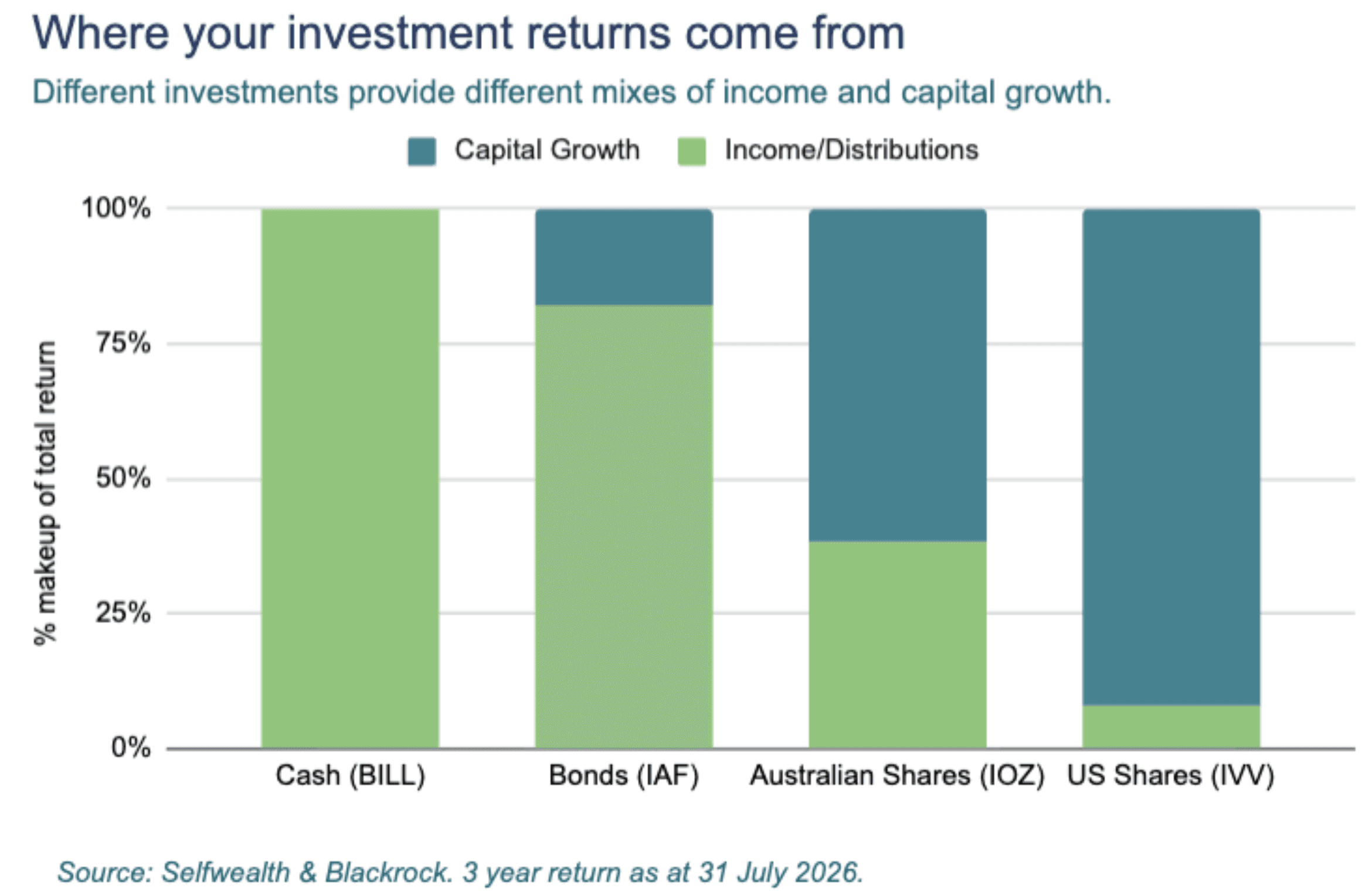
Cash: income is almost all of the return. The price barely moves.
Australian bonds: income stays positive, while price changes can add to or subtract from the total.
Australian shares: income is a meaningful part of the return, and price changes can swing the total a long way in either direction.
US shares: income is a much smaller part of the story. Most of the return comes from prices rising.
Australian shares have historically paid more of their return as dividends than US shares, which rely more heavily on the share price growing. Australian companies, particularly the banks and miners, pay out a larger share of their profits as dividends, and the franking credit system gives Australian investors a reason to prefer that. US companies more often retain their profits to reinvest, or return them by buying back their own shares, which shows up as a higher share price rather than as cash in your account.
This isn't fixed. There are periods where share prices fall and your total return is positive only because of the dividends you were paid.
Which number should you care about?
It depends on what you need the money for.
If you have expenses to meet and you need cash arriving each month, income is the number that likely matters more to you. You'd look at the distribution yield, and at how reliable that income has been. A high total return is not as useful if it's locked up in a share price and you might have to sell to meet expenses.
If you don't need the cash for years, total return is likely the number that matters. Income you reinvest and a rise in value both make you wealthier. Whether the return arrives as cash or as a higher price is largely a question of tax and convenience, not of how well you've done.
Most people are somewhere in between, and that's fine. The point is to know which question you're asking before you compare two numbers.
Why a yield is not an interest rate
A savings account rate is a promise. The bank has told you what it will pay, and it pays that until it tells you otherwise.
A distribution yield is a description. It's what the underlying investments are currently paying, expressed as a percentage. If the investments pay less next month, the yield falls.
A quoted yield can also be measured in more than one way. Some are backward-looking, based on what was actually paid over the past twelve months. Others are forward-looking, based on what the current holdings are expected to pay from here. The two can differ quite a lot when rates have moved. It's worth checking which one you're looking at, and whether it's quoted before or after fees.
What makes a yield change
Interest rates. When official rates rise, investments that lend money can charge more, and the income they pay rises. Floating-rate investments pass this through within weeks. Fixed-rate investments don't, because their rate was set when they were issued.
What lenders are charging borrowers. Separate from official rates, lenders sometimes demand more to lend, usually when they're more worried about being repaid. When that happens, newly issued loans pay more.
Company profits and dividend decisions. For anything holding shares, income depends on what companies choose to pay out. That follows earnings, and it follows management's view of whether to reinvest instead.
The value of the investment itself. Yield is income divided by value. If the value falls and the income doesn't, the yield goes up. A rising yield isn't always good news.
Read more
Frequently asked questions
What's the difference between income, yield and total return?
Income is the actual cash an investment pays you — dividends from shares, coupons from bonds, or distributions from a fund. Yield (or distribution yield) expresses that income as a percentage of what your investment is worth, so you can compare across investments of different sizes. Total return is everything you end up with — the income paid to you, plus or minus any change in the value of the investment itself.
Is a higher yield always better?
No. A higher yield tells you an investment is designed to pay out more along the way, but it says nothing about your total return. In the examples above, a 3% dividend yield delivered a far higher total return than a 4% yield in a good year, because the share price rose. A low yield doesn't mean a poor investment — it usually means the investment isn't built to pay much income.
Should I focus on yield or total return?
It depends on what you need the money for. If you rely on cash arriving regularly to meet expenses, income and the reliability of that yield might matter most to you. If you don't need the cash for years, total return might matter more to you, since income you reinvest and a rise in value both grow your wealth.
Why isn't a distribution yield the same as a savings account interest rate?
A savings rate is a promise — the bank tells you what it will pay until it says otherwise. A distribution yield is a description of what the underlying investments are currently paying, so it can change without any announcement. Yields can also be measured differently — some look back over the past twelve months, others forward at what current holdings are expected to pay — so it's worth checking which you're seeing, and whether it's quoted before or after fees.
What makes a yield change?
Four main things: official interest rates (rising rates generally lift the income from lending-based investments), how much lenders are charging borrowers, company profits and dividend decisions for anything holding shares, and the value of the investment itself — because yield is income divided by value, a falling price can push the yield up even when nothing good has happened.
Why do Australian shares tend to pay more income than US shares?
Australian companies, particularly banks and miners, historically pay out a larger share of their profits as dividends, and the franking credit system gives Australian investors a reason to prefer that. US companies more often reinvest their profits or return them through share buybacks, which tends to show up as a higher share price rather than cash in your account. This isn't fixed and varies over time.
Important disclaimer: SelfWealth Pty Ltd ABN 52 154 324 428 (“Selfwealth”) (AFSL 421789). The information contained on this website is general in nature and does not take into account your personal situation. You should consider whether the information is appropriate to your needs, and where appropriate, seek professional advice from a financial adviser and/or accountant. Taxation, legal and other matters referred to on this website are of a general nature only and should not be relied upon in place of appropriate professional advice. You should obtain the relevant Product Disclosure Statement for any product mentioned and consider its contents before making any decision.
Most Recent Articles